
Is your building ready for an inspector from the Los Angeles Department of Building and Safety?
Because the goalposts just moved. I’ve spent three decades in Southern California, and if I know one thing, it’s that playing catch-up with regulators in this city is a losing game. The 2026 National Electrical Code (NEC) is now operative as of January 1, and it isn’t a suggestion. It is a mission-critical update for your facility. If you’re an SMB owner in DTLA or managing a warehouse in the San Fernando Valley, these rules are about to hit your bottom line.
Let’s break this down.
The All-or-Nothing Rule for Damaged Wiring
I grew up in Shreveport, where we respected the heat and the water. If a pipe burst or the sun baked something for too long, you fixed it right. The NEC is finally taking that same straightforward approach to your wiring.
In the past, if your facility had a minor flood or a small electrical fire, you might try to salvage what you could. You’d dry out the conductors or trim back the scorched ends. The 2026 Code ended that.
The rule is now explicit: if your conductors or wiring methods have been damaged by overheating, fire, or water, they must be entirely replaced. They are no longer suitable for use. Period.
It’s not because the regulators are being mean. It’s because internal degradation from water or extreme heat is a silent killer for electrical systems. I’ve seen LA businesses try to “patch and pray” after a heavy rain. It never works in the long run. If an inspector sees evidence of water intrusion in your conduit, you are pulling new wire. Take a step back for a second and think about the cost of that delay. It is better to plan for a full replacement in your maintenance budget than to get a “stop work” order in the middle of a project.
The Small Detail that Trips Up Big Projects
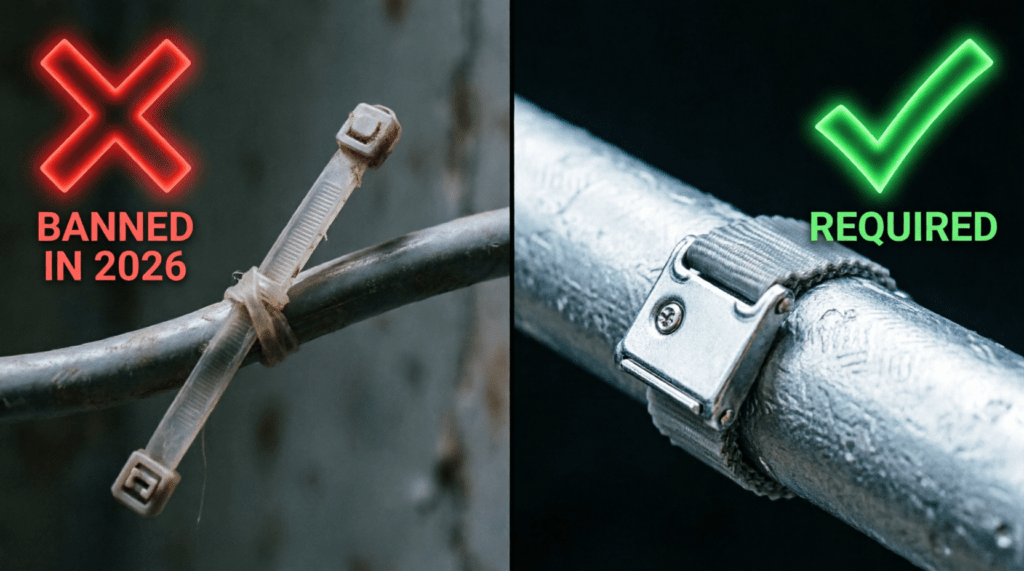
Here’s the thing about cable ties. Most people think a zip tie is just a zip tie. If you value excellence, you know that the details matter.
The 2026 Code now mandates that any cable ties used to secure and support flexible conduits or cables must be specifically listed and identified for that purpose. You can’t just grab a bag of standard ties from a big-box store and call it a day.
If those ties aren’t rated for the weight and the environment, you’re failing your inspection. This is a tax on your costs if you have to re-tie miles of cabling because your contractor cut corners. I’d like to think every pro in the LADWP or SCE territories knows this, but let’s be real. Standard white zip ties are for cable management behind a desk, not for supporting flexible conduit in a commercial ceiling.
EVSE and the Power Grab
Now we need to be real about the EV charging situation. We’ve talked all year about the “AI Power Grab” and the grid being full. As more Los Angeles facilities install commercial EV charging stations to take advantage of LADWP rebates, the safety risks are climbing.
Permanently installed commercial EVSE must now be installed by “qualified persons.” This isn’t a DIY job for your general maintenance crew. You need pros who understand the intersection of high-voltage loads and grid communication.
The biggest kicker is the new emergency disconnect rule. To protect first responders, your EV charging station needs an emergency disconnect located between 20 and 100 feet away.
Think about why this matters. If a charger catches fire in your parking lot, a firefighter needs to be able to kill the power without walking into the danger zone. If that kill switch is too close, it’s useless. If it’s too far, they can’t find it in time. This isn’t that complicated, but it requires smart siting and clear labeling. If you’re retrofitting a lot in Santa Monica or downtown, you need to map this out before you pour concrete.
The Bottom Line for LA Facility Owners
The energy landscape in 2026 is evolving faster than most buildings can keep up with. Between rising rates and the grid bottleneck, your infrastructure is either your biggest risk or your best asset.
I’ve learned that cutting corners on the foundation always costs you double later. These NEC changes are the baseline for 2026. If your firm isn’t squared away with these updates, you are paying a “Vulnerability Tax” in the form of failed inspections and safety risks.
You don’t wait for the storm to start before you check your gear. You get it ready while the water is calm. Look at your wiring. Check your zip ties. And make sure your EV stations have a clear kill switch.
The smartest players in Los Angeles are already building their own networks of resilience. They’re building to the 2026 standard today. The only thing you have to lose is your next project to a firm that built faster, safer, and smarter than you did.
Is Your Facility Regulatory-Ready?
Don’t let a failed inspection stall your 2026 growth. At Network Cabling Los Angeles, we look at buildings through the lens of readiness. We can provide a compliance assessment for your Los Angeles facility within 48 hours.